Showing posts with label Machiavellianism. Show all posts

Thursday, 9 June 2016

Machiavellianism Q&A Summary + Download

Three Modern Machiavellians


To my magnificent readers! As requested, a condensed version of the Triple Question & Answer Session by IllimitableMan, Illacertus and Modern Machiavelli including a pdf to download. You can download the pdf below:


Modern Machiavelli – Triple QA of Power


Feel free to share the pdf, the whole article or parts of it, as long as you refrain from editing it. You also are required to link to the following article to avoid confusion: http://modernmachiavelli.com/q-a-power-machiavellianism/


Workplace


Question: What is the best & fastest way to get ahead and promoted at work?


Answer (MM): You won’t like this answer but “it depends”. Since you didn’t give us much to work with, here are the basics:


Get accustomed to the specific workspace politics, know what is looked upon with favour or disfavour. Find out who the important people are and learn about their character, strengths, needs and weaknesses.


As soon as you have a basic overview, you want to web a net of allies. Especially but not limited to the bosses. Adhere the law 1 of never outshining your master. It is important to stroke the ego of your boss and present him in a good light. Yes, he is sometimes going to steal your credit, but this must not concern you. You must also make sure that your co-workers are on your side and not actively working against you behind your back. Don’t put too much trust into them though, and try to keep your private and professional life separated. Don’t believe that you are all loyal friends when you are going out, getting drunk and acting out of order.


This especially applies to company parties. Never get too drunk and make a clown out of yourself. Unfortunately many people break this rule.


You need to make sure that your reputation stays untainted from such mistakes. Guard your reputation with your life.


When shooting for the promotion, it is a wise move to conceal your intentions to not arouse envy in your co-workers who might sabotage you. Unless you are certain that they are allies on your side and most likely going to help you. Again keep in mind that it is good to trust people, but not doing so is better.


Lear to keep people depend on you, yes, but do not become the person who does his job so great that he cannot be promoted without a significant hit to the department’s productivity.


A thing I pay attention to is to court attention at all costs. Try to get a desk as near to your boss as possible. Make your name brand itself into the conscious mind and be associated with positive traits.


Creativity


Question: How do you put yourself in a good mindset in order to boost your creativity when there is social pressure against it?


Answer (MM): Creativity is snake oil and does not exist.


Creativity is a function of knowledge, experience, intelligence, mindset and your current mood.


How do you get comfortable? Stoicism & Confidence


Politics


Question: What is the best way to get started in Politics and to gain power, maintain power and survive in this environment?


Answer (IM): Learn Machiavellianism and become likeable, or someone people love to hate due to reprehensible behaviour but find absolutely charming. Charm does a lot to mitigate the adverse effects of dubiousness, and will allow you to get away with murder should you be sufficiently charming. Charm makes you likeable regardless of your ethics, remember this and incorporate it into your persona, it will do much for your personal power.


There are no “wikihow” style bullet points you can rote memorise to get power, if it were that easy, everybody would have power. Power is a cut throat game where only the most cunning thrive. Deciding to study power is taking the first step from pawn to player, but the rest is ultimately up to you. Study, learn charm, fuck up, and learn from your failures. Fuck up some more, then tell everybody about your fucks up one day so your enemies can’t use them against you. Do it with charm, and those who feel betrayed won’t be able to stay mad for long – many will forgive you. “It is easier to ask for forgiveness than permission.” The game is a dirty yet beautiful thing, the shades of grey within it surpass more than a mere fifty.


Most of the senior politicians have read Machiavelli, you should too.


Answer (MM): Starting in politics is unbelievably easy. I didn’t start getting (seriously) involved with politics until my mid-twenties and am constantly moving up in the food scale, with the highlight of recently having been promoted to the speaker for something.


You need to be aware of the skillset required to become successful as a politician. Without the following most important skill to possess as a politician, you are lost. No reason to even try. It is:


Be able to drink at least 2 bottles of wine without getting drunk.


You will probably believe that this is a joke. Well, 50/50. I want to stress the importance of networking.


There is not a single skill more important for rising the ranks. Study Social Interactions, know what types ofCharisma exist and which one is best suited for you. Learn to speak well. With authority, demanding respect. Confidence & Narcissism are beneficial and you should try to look your best.


I can not stress the importance of networking enough. Find out what activities your party has planned and do everything. Hand out flyers, sit in the voting booth, attend speeches, help prepare events, etc.


This brings me to another topic. Clothing style. I am in a “worker” party where the grunts dress casually. How do the ministers, parliament members & chancellor dress? They wear suits. Even if I wouldn’t trade in my own mother for Zegna suits, I would still make sure to dress like a king, to be treated like a king.


Of the utmost importance is a proper knowledge of the human psyche. 90% of everyone is out to prison rape you, given the chance. Maybe not at first, but the higher you move up, the more political schemes are involved. Master the art of strategic thinking and again, trust nobody.


In every party there are recruitment sections. My party for example has 5 different ones and they are all eagerly looking for fresh blood. Do some research about which party currently is in power and about the expected trends and choose your party based upon it. Or go with your “principles” or whatever that is and choose a bad party that aligns with your interests. Cognitive dissonance is overrated and it is a good exercise defending a point of view that goes against everything you stand for. Write them, phone them or show up at a meeting and introduce yourself to everyone. Remember their names, be likeable, connect with them on facebook and especially important, a mistake that many newcomers make: open your mouth. Too many newbies are too scared to voice their opinions and therefore never stand out. Of course, I know, at first it might be intimidating if some people who have been in the party their whole life speak without points and commas, but you need to give your input and if someone tries to interrupt you, don’t let them.


Cooperation


QuestionHow can you convince socially unprotected workers, in the care for the elderly, to cooperate for their own good and work together to fight getting exploited. They are suspicious of each other and their reaction is to defend themselves aggregating according to nationality, family, religion, bit many are isolated and there is an entire culture of acceptance of a miserable life which nourishes sentiments of despair, hatred, depression, self-abuse, victim-like mentality, sometimes delinquent.


Note: there is no money to pay them for it, no promise of power over them, no immediate reward.


Answer (MM + IL): Sounds like you don’t need manipulation, but leadership skills. Obviously, you want them to work together as a team, but they’re unmotivated. Have you tried explaining to them how and why it’s in their own best interest to work together? In other words, do they fully grasp the mission at hand and what lies in it for them? I’m afraid we do need more insight to give more precise answers.


How do you convince people to work together?


Either you create an outside enemy. Tell them that they must work against a common enemy and for a shared goal.


Or you find out what they want and let it dangle in front of them like the carrot on a stick.


You win some; you lose some. People with such a fatalistic attitude are difficult to motivate. Them forming groups is an obvious reaction since this is human behaviour 101.


I would try to create the vision of a beautiful goal in their heads and tell them that to achieve said goal, they will need to work together. Or do the same with negative disaster scenarios. Fear is an excellent motivator.


Then your leadership and mediation come into play. Organize events where you make sure that they come in contact and realise that they share a lot in common.


Over emphasise the commonalities and ignore the differences.


Maybe thinking about what motivates people will lead you to achieve your goal. The biggest factors are:


  • The possibility of benefits & recognition

  • The fear of loss & pain


Cult of Personality


Question: How would one go into building a cult of personality?


Answer (IL): Study Apple (the cult) & Steve Jobs (the personality).


Also read;


You’re better off building a “cult-like” following instead of a cult. One is building a personal brand with an audience – the other is creating a new religion. Basically, learn how to build a business.


It’s about entrepreneurship & your best bet is creating something valuable that will add to people’s lives. Be a great leader and people will follow you based on your actions.


Answer (MM):


Step 1) Unde Venis?


Where do you come from? Analyse your strengths and weaknesses. Do an SW Analysis


Step 2) Analyse the Terrain


Do an TO Analysis. Carefully evaluate the threats and opportunities, both on the micro- as also in the macro- environment


Step 3) Quo Vadis?


Where are you going? Decide exactly how you wish to be perceived.


Men in general judge more by the sense of sight than by the sense of touch, because everyone can see, but only a few can test by feeling. Everyone sees what you seem to be, few know what you really are.


Perception is reality


Step 4) Craft your Backstory


It has to be appealing to the public and give them a reason to like you. Terrific examples of background stories (you can combine them) are:


  • Reluctant Hero (Actually you do not want to be famous or have responsibility, but it was forced upon you nevertheless. You reluctantly agreed to accept the call of duty)

  • The Underdog (Everyone hates you, nobody gave you a chance)

  • Us vs. Them Dynamic (You have a mutual enemy and only you can save them)

Step 5) Spread your Message


Start the engine of the propaganda machine and spread your message via Marketing & PR channels and techniques.


Step 6) Evoke Emotions


  • Social Proof – Show that other people love you. Especially influential people

  • Trust – Bond and connect with others

  • Credibility & Expertise – If you don’t have it, borrow it from others

  • Repetition – Repeat that you are the greatest and soon both you and others will believe it. Repeat it often enough and you will be the double greatest


Evoke Fear


Question: One of the important points of Law 24 (Play the perfect courtier) is to make others fear your power. How do you make others fear your power while maintaining a friendly vibe with others?


Answer (MM):Always be nice, until it is time to stop being nice. I am certain that you are aware of the old saying “an eye for an eye, a tooth for a tooth” and I guess you agree with it?


I don’t. If someone takes my eye, it take both of his. Always be friendly and easy going, praise, approach people in a sycophant way, be suave, be the perfect gentleman and courtier but hone the reputation of being a fear-inducing enemy.


Be aggressive, even if you fake it. Studies have shown that even if you fake being angry & aggressive and people are aware that you fake it, they will still get scared.


If someone cuts you off, cut his tongue off. Never allow yourself to be interrupted by equals and inferiors (please don’t use these techniques with your superiors, unless they are lying on the ground).


If someone starts an ad hominem attack against you, stare into his eyes. Open your eyes as wide as possible, don’t blink and never for one second look away. Here is an example of a perfect stare and keep in mind… the Duce is happy in this picture. Imagine the soul draining stare he gave his enemies. Also make sure that you are facing him in a straight line and not from an angle.


Also, use sugar bread and whip. Reward and punishment. Condition people like Pavlov conditioned his dog. Related Law: http://modernmachiavelli.com/law-12-use-selective-honesty-and-generosity-to-disarm-your-victim/


Question: What if you want to take both the eyes of your enemy but your enemy is not trying to take yours?


Answer (MM): Convince yourself and the public that he is secretly planning to take your eye. -> Take his eyes.


Reading People


Question: If you’re just starting out. What training system for learning to read people, channel emotion, become more mindful and present. Do you recommend?


Answer (IL): Study people in real life like you would observing a lab rat. Micromovements in the face, body posture and tone give away everything. I believe most of it is in the eyes, no matter what circumstance a person is in. You could read What everyBODY is saying, but there’s plenty of other good books on the subject. Tbh, I haven’t learnt any of this through books, rather through silent observation.


For full control of your emotions & for mindfulness read & practice stoic philosophy. For presence meditate & read Eckhart Tolle. I’d apologize for a short answer, but I do think it’s that simple.


Still, let me add to your question on emotions. Emotions can be so powerful that we just can’t suppress them at times. You can use this to your advantage and add it to the list of things that make people easily readable. At the same time, you want to practice your poker face. When you play a prank on someone and can’t keep yourself from laughing you’re fairly bad at it. The victim of the prank will sense that something’s up since you’re acting weird. It does not matter what you’re feeling on the inside, a good poker face handles all emotions.


I used to get angry a lot at my old job, sometimes to the point where I could feel my temperature going up to fiever-like symptoms, where I feared my head would look pepper-red on the outside. I also learnt to avoid making fists & have my hands open instead. I could’ve blown up and it would’ve felt good at that moment, but you remind yourself that the temporary satisfaction you get from releasing that tension would have consequences. If someone fucks you over, calm yourself down with the thought of taking revenge or sort things out in the future on your own terms. Same thing with emails. Never write them in anger or atleast save them as a draft in order to review them at a later date. Most often you will find that you were too emotional and thankful you didn’t click send.


I once reached a moment where I was ready to quit my job right then and there. I decided to give my decision another three days & things turned around. My problem was solved for me and I had nothing to do with it.


Answer (MM): I highly recommend you to read this book. It gives you an excellent overview of the body language signals and non-verbal communication. While humorously written it is a science based, no bullshit approach to the topic, backed by many examples and pictures to properly understand the dynamics behind body movements. We learn how to detect our own body language missteps and also why Churchill liked to cover his crown jewels with his hat, as well as cultural differences.


The Full Facts of Cold Reading is another great book, unfortunately I don’t have it listed in the books Machiavelli would read, so I can’t provide you with a link.


Charme


Question: What is charm, and how can you develop it? Any good resources?


Answer (MM): Charme and Charisma are closely tied together but there still are a few differences, though so minor that we are going to ignore them for the sake of this post.


Charme is important to charm your opposite, be it male or female, into agreeing with you. One could say that charme makes people say yes. Even if you didn’t ask a question.


There are a few things that play together:


  • Your attractiveness level, including grooming, odor, clothing.

  • Your power & status, but also knowledge and expertise fall under this category.

  • Authority & calmness

  • Your body language & confidence.

  • Your humour.

  • Empathy & your presence in the here and now. Ergo listening without becoming distracted.

  • Your agreeability and likableness.

There is no denying that a powerful person always has more charme than his inferiors. There have been studies where actors assumed the same body language and were equally attractive, were paired up against a powerful person. The effects of charme and humour were measured and it turned out that the powerful person scored much better.


Now how can you learn to be more charming? My book recommendations that cover every important aspect would be:


This covers everything except for humour but I fear I can not help you with that. In my opinion, you either have humour, or you don’t but many people claim that humour is a learnable skill. Anyway, it was never of interest to me but I am sure that you will find some sources teaching the art of humour.


Question: What is a good resource for learning the different types of charisma?


Answer (MM): They are all explained in The Charisma Myth. I didn’t get a lot out of reading it and in my opinion, it is a little hyped, but still makes for a good read since there are few reliable sources (not talking about 7 step self-help hippie bullshit gurus) about Charisma.


Books about Manipulation


Question: What books about Power & Manipulation can you recommend?


Answer (IM): The Craft of Power, The Prince & 33 Strategies of War are great texts for this purpose. Also, check out my reading list and Illimitable’s to find an abundance of suggestions.


Answer (IL): I’d add to IllimitableMan’s great picks;


Game Theory


Question: How do you decide when your attempts at attacking/ defending someone should stop? 


Answer (MM): Base your calculations on experience and possible outcomes. Assess the risk and decide.


Read up on Game Theory and visit /r/gametheory/ as well as /r/gamesandtheory and of course master strategy while reading http://reddit.com/r/the48lawsofpower


Also follow /u/ridik_ulass who is an excellent game theorist and strategist as well as a mod for multiple useful subreddits.


The 48 Laws of Power


Question: What so you think is the motive for law # 1 in Greene’s book to be Don’t outshine the master?


When he wrote the book he surely didn’t let some random function dictate the order of the laws. They say the first and the last elements of a list are those that are more remembered.


Answer (IL): As you rightfully point out the author starts and ends his book with much thought. Law #1 is the first law almost everyone seems to break. We get into the business world with much euphoria and the attitude that we’re going to prove ourselves one of the best employees available on the market. We’re going to rise up the ranks fast and have a career our parents can be proud of. We’re naive and to a certain extent arrogant.


We don’t realize that many authorities rise to their ranks for the thrill of control, which they falsely belive is power. They’re managers, they’re not leaders. Either way, they have fragile egos, lots of insecurities, failed dreams and here you come – the greenhorn. The young adult who always has a positive attitude, who outworks everyone and learns fast. You’re a threat and you will be dealt with. It’s our ignorance and belief in the lies we’ve been fed that makes most of us walk right into outshining our masters, may that be superiors or merely colleagues. You’ll face resentment without understanding it. It’s pathetic.


Greene finished with Law 48 Assume Formlessness, which basically lets you understand not everything is set in stone and you have to know when to adapt to change and go with the tide, reforming instead of letting your rigidity be your downfall as we’ve seen with the Spartans. Simply put, you’re almost done reading the book and Greene tells you they’re different strategic moves on the chessboard. The experienced chess player will know the right move to make at the right time against the right opponent and alter his playstyle when necessary. You develop that ability through mastery.


Difference between Leader & Manager: One difference that will make you fill in the blanks would be that a manager will order a job to be done and the employee will obey, because he has to, out of fear and anxiety, always relying on his next paycheck. The leader inspires his followership to do something, because they want to do it. He does not micromanage, but lets them free under his guidance. They pursue goals based on their own will to do it. One forces you, the other does not decide for you and offers a take it or leave it approach. Leadership in the office is difficult to pull off, because of the structure one is in. You’re surrounded by people who don’t like their job, but depend on it. It does not matter what way you’d try to frame it. They can tell the difference between honey and salt.


The greatest enemy of knowledge is not ignorance, it is the illusion of knowledge.


If you can pull off to demonstrate to your victim that he in fact is delusional, then that would work. Normally they’re so deep into their own reality that one cannot reach them. Imagine telling Kanye West he’s an idiot by showcasing his failures to him. He wouldn’t fall out of the clouds, because of that.


QuestionHow have you applied these laws to your personal life?


Answer (IL): I’m careful not to step on anyone’s ego, be that a colleague or especially someone with authority, who prides himself with his status/position. I stopped trusting most people. I talk less & let akward silences sit without feeling the need to fill it with unmeaning words. I’m not as kind anymore. Many see it as a weakness. You basically invite them to believe you’re a “nice guy” they can step on. I stopped talking about future plans or things I haven’t done yet. It eliminates the possibility of sabotage. Once they notice your actions / accomplishments, e.g. that you’ve successfully outworked them / gone about improving yourself beyond their skills, they’re powerless, no matter how much insecurities you stepped on.


I mingle with others more instead of seeking isolation. You’re better off at the front, building and guarding your reputation. I try to avoid attention, but shine in a positive light, when it is forced on me. I avoid parasitical losers. I’ve tried to help them in the past only to find myself affected negatively by their misery. I avoid gossiping / taking sides at all times. I refuse to take a side and always stay neutral. The effect is that everyone feels like they can come and talk to you, open up and within record time you accumulate so much dirt on everyone around you, you’re the most informed and up to date person at your workplace / class / group.


Through my naive, innocent behaviour when first getting into the office I nailed that. You want to have people underestimate you. I’ll have my superiors take the credit for my work. They love you for it, become dependant on you & when push comes to shove, you already know exactly how to do certain parts of your boss’s job, since there’s nothing they love more, than delegate to someone who will deliver good quality work. I try to learn as much as possible from the managers & managers’ managers higher up in the hierarchy. Most of them are vain. Appeal to their self-interest, make them feel important. Don’t mistake this for arselicking. One is pathetic and will get you enemies among your coworkers, the other is subtle and best done when grabbing lunch together. You ask them, the last thing they’ll do is ask a lower employee for lunch without a reason. I control my emotions in public settings.


Can’t allow yourself to put your guard down. When people don’t appreciate you and you’re the one running shit, demonstrate that by taking a vacation leave. It has worked perfectly for me, when I had to deal with a parasitical coworker who tried to manipulate & cross me. I was very aware of what she was doing. She underestimated me. I dealt with her as subtly as possible. Some people, like her, dig their own graves and all you have to do is wait wth a smile on your face, when everybody hates working with them. It’s not a rarity. I want people to think I’m the innocent, young, naive, uninformed, little intern. They never suspect you could be a threat & as mentioned earlier, realize you’re outdoing them by miles, when it’s too late.


Be careful with appearances. People love to pretend they’re someone they’re not. Most people’s word doesn’t mean shit. They’re thinking something completely different. Also, I don’t answer honestly to personal questiosn like “What’s your plan for the future? Are you going to study?” I used to talk openly about my dreams, only to find out, I’d get resentment for not being the average joe who gets wasted every weekend. So, now I’m the average joe & repeat average joe shit to them, because I have to. I might be a bit of a romantic & think long-term relationships are possible, but the word “commitment” ends there. There’s no way I’ll let myself be trapped & just hand over all of my power to the naturally Machiavellian sex. See, there’s plenty of historical events where men used physical strength to fight with swords, but women, out of necessity, practiced the art of persuasion. There’s a power imbalance between the genders when it comes to sex. Commit & you’ve lost.


I always liked the idea of being royal in your own fashion. When I was an intern I gave no weight to my title. You don’t need a crown or a “senior” on your business card so people see who’s killing it. People choose a leader based on their actions. Your superiors might be managers, but that is not synonymous with leading. They have paid workers, not passionate followers. When something is for “free” I don’t want it. Even when you don’t pay with money, you will be expected to pay in another way. Most often that turns out to be a bigger struggle than the price you would’ve paid for it. Work on your connections. The more people like you the better off you are, always. Don’t build a fortress & lose sense of what’s going on around you. Be adaptable. Something doesn’t work out the way I planned, accept it, come to grips with it right then and there, then move on & work it out.


Morals


Question: Do you have any morals you live by?


Answer (IL): Indeed, if we weren’t we wouldn’t be holding this AMA or doing the work that we do, that is beneficial to many. If it were all just about money, I would be doing something else. I began to educate people on these topics like a Kung Fu master trains his students in the hopes they would use it to protect themselves better. Maybe one of 50 will learn only to bully others, but if that means the other 49 can defend themselves I’m happy. Also, if someone needs precise instructions in order to be dangerous, they’re not a real threat to begin with.


One thing I know the three of us share is loyalty. Quite contradictory to Machiavellian beliefs, but what is a man worth, when he speaks unmeaning words even to his own brethren?


Answer (MM):


Politics have no relations to morals


  • Niccolò Machiavelli

Question: How would you describe how your perspective on life in general differs from what most other people believe?


Answer (IL): I’m quick to sense when someone’s trying to manipulate me, even when it isn’t obvious. It’s essential to one’s success in the office, where the other is always trying to advance and thus sees you as a viable threat, when you’re doing a good job. Although I’m able to read people’s actions, I’m fully aware of the fact that I can fall victim to manipulation any day.


A narcissist might at some point believe that they’re invincible and immune to the deception of others. That very sentiment blinds them & makes them so much easier to manipulate, since they don’t believe it could happen to them. We’re very fallible & biassed. There’s this great quote by Shakespeare, who himself practised Machiavellian tactics.


“The fool doth thinketh he is wise, but the wise man knows himself to be a fool.” I don’t think I’m that intelligent. However, when I take a good look around me I believe I’m a genius waiting to be discovered. I think it is a fact we’re surrounded by people who couldn’t be more incompetent and unqualified to do their jobs, many of them in authoritative positions. Plenty of them mistakenly assess their skill level to be much higher than reality suggests. The Dunning-Kruger effect is at full play. A common mistake I see people making is operating on the assumption that the first-in, last-out the office worker bee always gets their deserved promotion based on merit. It’s primarily about popularity.


Answer (MM): Realism.


Take the refugee crisis for example. Of course, I feel like that most of them are poor souls that really require help. But some of them are bringing rape, criminality and terrorism into the heart of my country and this can’t happen. If you give me a bowl of smarties and tell me that 5% are poisoned, even if I would love smarties, how many do you think I am going to eat?


There is the common misconception that Machiavellians are worse than Hitler. They are not. Sometimes maybe…


I will share a great quote of my father with you: “Life is not about whether you drink a 2€ wine or a 100€ wine, it is about having the power to change things.”


And this is not a statement made by an unsuccessful bum trying to justify his failure in life, pretending that he has achieved the enlightenment because he does good deeds while living in a 1 room toilet-in-the-bathroom flat.


Power is sexy, it feels amazing and, just like the horny college student chases hot college tail, I chase power.


I am always looking out for my friends and family. Loyalty is my honour. This doesn’t mean that I am not prepared to cut off dead bodies dragging me down.


Some people are to be used as fuel in the furnace of power. That’s the way of life and having regrets or second thoughts only holds you back. You need to be realistic and pragmatic, no matter who you are or what you points of view are.


Self-Improvement


Question: How does one get their mind in shape. Controlling their emotions, becoming mindful, mentally acute and self-disciplined. How do you control your facial expressions, body language and talkativeness.


Answer (user Seducer4Real):


Here are 3 things I do to achieve the above:


  1. Read books everyday. I do about 20-30 minutes daily. Sometimes more on other days. The key here is to keep it consistent. Even if you do 10 minutes a day, keep it consistent. Don’t try to start reading 1 book a day/week. Build it up.

  2. Work out. If your body is in shape, your mind will benefit from it as well. I recommend you workout at least 3 times a week. If you’re not the type that wants to build muscle, then look into doing other sports such as boxing/martial arts that will also keep you in shape.

  3. This is a tip I learned from one of the greatest copywriters and business strategist – Gary Halbert. Essentially, you walk 1 hour a day at least 5 days a week. First few weeks will be hard but once you are used to it you will crave it like a cigarette, and unlike a cigarette, it is healthy for you.

You should get started with the above 3 for now to achieve mental clarity. Once you have those 3 in place, you will come up with your own techniques. Also, don’t replace working out with walking or vice versa, you do BOTH. 1 Hour walking per day plus working out 3-5 times a week.


Facial Expressions: Look at yourself in the mirror. Have an imaginary conversation and see what facial expressions you produce. You’ll learn a lot this way.


Body language: Don’t fidget when talking to someone. When talking use your hands to emphasise what you are saying. This makes you look more attractive and can create more trust between you and the other person. Make eye contact when talking. Try not to touch your neck/face/hair as it makes you look nervous. Don’t be reaching to your phone/pockets every few seconds.


Talkativeness: Don’t overdo it and don’t underdo it. Realise when it is a good time to speak, when to stfu & listen and when to give short replies. Most people are not interested in hearing your voice so you should be asking specific questions to get them talking. In other words, be a good listener and use wha they tell you to create conversation. Don’t always make them the centre of the conversation, instead relate your own knowledge/stories of that topic to them. If you’re with a few people you’ll have to judge when it is a good time to interject. Pro Tip: Don’t be quiet when you are in a group of people, you’ll just look weird/antisocial.


Wednesday, 1 June 2016

Psychological Manipulation Techniques

A list of almost 200 psychological manipulation techniques in no particular order; to you, my magnificent reader. Most are aimed at getting people to do what you want, but some also protect you from being deceived.  5000 words.


 psychological manipulation techniques


I decided to leave out cognitive biases and fallacies since the posts is quite long the way it is. But rest assured that I am going to dig into those two topics sometime in the future.


Psychological Manipulation Techniques & Tactics


  1. Never show people that you are upset, for it makes you appear weak. Social Justice Warriors take notice!

  2. If someone makes a joke at your expenses, pretend that you didn’t hear it, while looking straight into his eyes. A joke that has to be explained or repeated loses its’

  3. Make use of the Law of Reciprocity (By Robert Cialdini): People will feel obligated do a favour for you in return for your gift/kindness/favour.

  4. Multiple studies have found that clean shaven, well-dressed men are treated more favourably by judges.

  5. Learn to use fallacies, cognitive biases and dissonance to your favour.

  6. If you want to gain access into a person’s life, especially of one of the opposite sex, use subtle flattery.

  7. Whenever possible try to assume the role of the father (to women) or brother. People will easily submit their trust to you.

  8. The basis of authority? Body language, clothing style, financial resources, likeability/charm and intelligence. Combine them to lay the groundwork for all the other psychological manipulation techniques.

  9. The Deference Principle: People will trust you and follow your instructions if you appear to be a person of authority.

  10. Walk like a King to be treated like one. If you act and appear to be in a position of power, you will soon be.

  11. Use the Door in the Face technique. Make an enormous request (like https://en.wikipedia.org/wiki/Cristobal_Colon did when asking for funding of his expedition) without the intention of having someone accept it. If you follow up with a small request afterwards, you are much more likely to have your request granted.

  12. Similar to the Foot in the Door technique. Ask them for a small favour and if they agree, follow up with a larger request.

  13. If you want people to agree to your request, offer to do a little part of it, they are much more likely to agree if they see your good will.

  14. The Placebo Information. Give people any reason using “because” in the request. Studies have shown that the compliance can skyrocket, when giving any reason for your request.

  15. Propaganda masterminds know that repetition is an excellent way to convince people of something. The sweet spot for repeating something lies between 3-5 times, according to studies. After that diminishing returns set in.

  16. Overwhelm people by speaking quickly and overload their brain with your information or views. This psychological manipulation techniques may both be used offensively as well as defensively.

  17. People love people who like them.

  18. Use positive affirmations. Tell yourself that you like your vis-à-vis or that you are not only the greatest, but the double greatest.

  19. People hate people who hate them.

  20. Whenever you want someone to cooperate, agree with you or want them to calm down when angry, stand in a 45° angle to them or next to them.

  21. Standing or sitting in a direct line of a person tricks the brain into believing that the vis-à-vis is an enemy.

  22. People will be more likely to do you favors if you make more physical, platonic contact with them. Note the word “platonic”. Unless they are attracted to you, flirtatious behaviour will make them more aloof. One of the highly successful psychological manipulation techniques, frequently used subconscious.

  23. Be aware of whether a person is a “thinker” or a “feeler” and target your message accordingly. Most people though value emotion over rationality.

  24. The three elements of every speech or debate? Logos (the Content/Argument), Ethos (credibility/authority) and Pathos (means to influence his audience or opponent, emotional appeal).

  25. Caffeine increases the situation awareness and alertness. Usually a good thing, though it can be used for manipulation. A person on caffeine is more easily influence than he would otherwise be. A study found out that people are 35% more inclined to agree with you, if high on coffee.

  26. Reversal: People who are tired, are easier to manipulate as well.

  27. As a woman it is mandatory to never wear too much or too little makeup, unless you wish to come across as untrustworthy and unsympathetic.

  28. Ask for a favour at a time most convenient for your target, making him less likely to refuse. No brainer, but I still want to empathise the need for proper timing.

  29. If you want to manipulate people, alter their mental state. A scared, stressed, shocked or anxious person has less inclination to refuse. Reason is that they think with their primitive limbic system, which only knows black & white, but no shades of grey.

  30. Of course, the modern Machiavelli must not only use mental manipulation techniques but must also know how to recognise emotional manipulation, to not end up being the one deceived. A stoic mind helps and allows you to focus and think rational, making it easy to spot the characteristics of a manipulative personality.

  31. Chew gum before or during a stressful situation to trick your mind into thinking that there can’t be an immediate danger, because you are “eating”.

  32. It is possible to manipulate feelings and perceptions based on an object someone is touching. Heavy object = thinks more seriously about things. Rough object = pessimistic train of thought, bad mood.

  33. Hard chairs make for a hard negotiation. People sitting on them are less likely to cooperate.

  34. Women seem men wearing red as attractive and desirable. Men wearing blue as more stable, as boyfriend material. White = innocence.

  35. A two-sided argument refuting the opposite argument is more persuasive than a one-sided argument.

  36. Light swearing at the beginning or end of a speech, debate, etc is often beneficial as it increases the audience’s perception of the speaker’s intensity.

  37. What everyone is aiming for: Affiliation, being liked, accuracy and a positive self-concept, ego.

  38. Tell people that they look/are exactly the person who would do xyz.

  39. Convince them that you are Jesus Christ reborn. Pretend to be loved by everyone to create massive social proof.

  40. Never use qualifying words (maybe, probably,…) when trying to influence people. Instead, frame your words in a way that makes them sound like you are only stating confirmed, definite facts.

  41. How to manipulate people into thinking that you pose no threat? Look harmless and pretend to be the wolf in a sheep hide. Perception is reality.

  42. Charles Manson tips on recruiting: Always keep the mood positive, tire them out, get attractive people to charm them. Interesting fact: his most favourite book, the foundation of his artful psychological manipulation techniques is the following book: How to Win Friends & Influence People

  43. Show interest in other people. If you do, people are more likely to like you.

  44. People gravitate towards those with a strong reputation, even if their gut tells them that someone else, though more obscure, is a better leader. Keep this in mind while mentally manipulating groups.

  45. Want to keep people down whose nutrition you can dictate? Keep their schedule busy and feed them a sugar-based diet.

  46. When dealing with a religious person, swear to god that you are telling the truth, when lying.

  47. A person who frequently draws attention to his genitals(scratching, adjusting down there. Holding his belt with his thumbs, ergo taking a manly stance) values his masculinity. Attacks on his masculinity will hurt him much more while he will love to hear compliments about it.

  48. Mirror other people’s body language and actions. Don’t do it instantly, because they will catch up on it, but do it with some time delay. Attention: People trained in NLP will most likely catch your mirroring attempts.

  49. Repeat a person’s name often during a conversation. Not only will this help you remember it, it makes him like you more.

  50. Match your speech (speed, use of words, pitch) to your vis-à-vis to build rapport

  51. Match your breathing, blinking and walking speed to them

  52. Belief and emotion trumps rationality and logic.

  53. Show, don’t tell. Manipulation is much easier if you base it upon tangible things and emotion instead of talk. Win through your actions, never through argument.

  54. Avoid the bright spotlight. The darkness and shadows are your friend.

  55. Give people the illusion of choice. Make them play with the cards you deal.

  56. Women who tilt their heads back come across as less feminine, chin down = more attractive. Making the orgasm face (think of Marilyn Monroe) makes them more attractive, as well as signs of submission like high eyebrows or revealing the neck.

  57. Obey your father. This was already written in the bible (I believe) and can be used to effectively deliver advice. Say “my father once told me, that it is best to do xyz that way”.

  58. Men who tilt their head back are considered more masculine. Men who show signs of submission are less attractive.

  59. Calibration is an essential tool of the skilful manipulator. Gauge reactions and emotions and adjust accordingly. If you see that you are overwhelming someone, slow down.

  60. Different wording can make all the difference in manipulation attempts. Spin doctors excel at this and re-word a massive tax increase in a way that makes voters agree with it.

  61. It is much easier to make an optimist passionate for something. Avoid the toxic & pessimistic people, because they often are harder to fall victim to psychological manipulation techniques.

  62. One of the strongest tools to shame someone is to accuse them of being creepy. This is a word nobody wants to be associated with.

  63. Emphasise scarcity. People want what they can’t have, or at least what might be running short.

  64. Reversal: Abundance. If you come from a place of abundance, are known for or appear to not be needing the deal/the girl/the job, you are in a favourable position.

  65. Dominance is sexy. Women are more likely to agree with something, if they are touched on the arm during the request.

  66. Squeeze people for the last penny. Be bold with your demands. Show no mercy because you will not be shown any. If you give someone a finger, they will take your whole arm.

  67. Science confirms that strong emotions make people fall in love faster. Watch horror movies, rob a bank, create adrenaline.

  68. Want someone to agree with you? Start asking them something you know they are going to agree upon, even if unrelated. For example ask a liberal person “I hate Hitler, do you like him?”

  69. Find out your common interests and strengths and exaggerate them, while downplaying or ignoring any differences that exist between you.

  70. Women who smile are more attractive. Men who smile less and appear serious are more attractive. Attractive equals charisma and makes it easier for you to use psychological manipulation techniques on your target.

  71. When you asked the buying question, shut your trap. Never make the mistake of talking yourself out of a deal.

  72. If you were forced to make an apology, delivered it artfully and it was accepted, the same rule applies. Immediately stop apologising lest you want to talk yourself out of the apology.

  73. Usually, when your apology has been accepted under protest and grumbling, it is best to not apologise again, for you might draw upon you resentments waiting to come at you. Giving it a little space and time is the preferred course of action here.

  74. Never ever do the mistake to give your target reasons to not do what you want them to do. Sounds basic? It is not.

  75. People like people who are like them. A narcissistic HR person is most likely to hire a narcissistic candidate.

  76. It is human nature to trust their fellow man, hence are naturally born naive, susceptible to psychological manipulation techniques.

  77. People who have recently eaten are easier to convince of something. Maslow’s Pyramid of needs at work.

  78. Never immediately end a conversation after getting the information you need. Ask a couple of inconsequential questions or chat a little. Later, when the target tries to remember the conversation, they will most likely only recall the last 2 questions.

  79. Security is often an illusion. Never drop your guard, especially not at a business party, never reveal too much.

  80. Never believe a conversation to be confidential.

  81. A man convinced against his opinion is of the same opinion still.

  82. Avoid the direct confrontation when you argue with someone, hoping that he will change his opinion. Even if they agree to your point of view, they will despise you for it.

  83. When asking for a favour, it is only beneficial if you ask for it in front of the public/other people. If they agree, they look kind, and they fear that if they disagree they might look cold.

  84. If you want your target to agree with you, nod while asking the question. If you want him to disagree, shake your head.

  85. When asking for a favour, it is beneficial to appear dominant. Look them straight into their eyes. Intimidation is an excellent foundation for psychological manipulation techniques.

  86. Dominate & intimidate by looking at your vis-à-vis’ forehead or hairline. This is going to subconsciously evoke feelings of inferiority and insecurity in them.

  87. Speaking of dominance, muscles do help, as well as a bald or clean-shaven head have been shown to have a positive effect on your ability to follow up with psychological manipulation techniques.

  88. Being thin and therefore having a chiselled jaw makes you appear more dominant. A wide chin is a sign of high testosterone.

  89. Don’t overdo it but take a sentence, rephrase it and feed it back to them. This gives them the illusion that you are an avid listener and interested in them. Also known as “reflective listening”.

  90. Many people enjoy helping, hence, if you have a request, you can start by stating that you need their help.

  91. If you see a bum and know that he is going to turn to aggressive begging techniques, ask him for money first to utterly confuse him.

  92. If you feel like someone is telling only half the truth, utilise the tension of silence and stare at them.

  93. Develop a stare that would make Mussolini proud. Staring someone down can be very beneficial during a confrontation.

  94. Keep eye contact but don’t overdo it. People who lie often hold strong eye contact, despite popular opinion that they look away. This falls under the “silent” psychological manipulation techniques.

  95. Don’t give signs of confirmation all the time while listening. Ergo don’t nod all the time or say “mhm/I agree”. This reveals your approval seeking agenda.

  96. Flatter, but never flatter too much. Also, be careful when people are shy, because they will often resent compliments. Confident narcissists can’t get enough of them on the other hand.

  97. Not only observe your target, but also the reactions of their friends. Sometimes the friends reveal your targets real thoughts.

  98. Taunt your target into delivering excellent results, but questioning his abilities. Enraged people will go out of their way to prove you wrong. Use sparingly.

  99. Touching guests, having a cheerful mood, giving them free sweets and drawing a smiley on the bill, increases the tips of waiters (and of prostitutes).

  100. Ask questions to throw people off balance. For example, if someone is playing well (Poker, Sports, …), ask him what he changed about his game because he usually never plays that good.

  101. Using a frame breaker in the form of doing something unexpected or asking annoying questions can be used in many other Situations as well.

  102. Arrogant sales people sell more to rich buyers in outlet stores. This also applies to real estate. Adapt to your customer and you might even find psychological manipulation techniques obsolete in some scenarios.

  103. The illusion of irrevocability says that people will change the way they think about something to justify their behaviour. If you gas enough people of a particular race/ideology because it is your job, you are guaranteed to despise those people.

  104. Never underestimate the importance of a first impression. This combined with the halo effect can be either beneficial or catastrophic for you.

  105. Divide & Conquer. Alienate people to make them depend on you or to weaken the enemy from within.

  106. People who think that you are a good-for-nothing-asshole are going to convince themselves that you indeed are, even if you start handing out soup to the homeless and rescue kittens in your free time. People hate being wrong and hence will try to convince themselves that their opinion of you was true.

  107. Be bold, be confident, ask for more rather than less, exaggerate your skills and achievements, dress and groom well. The basics of every job interview or political speech.

  108. Use reinforcement to manipulate people. Both positive and negative as well as intermittent or partial reinforcement.

  109. Use sugar bread & whip, rewards & punishment. Use selective generosity to lower defences.

  110. Enthusiasm is contagious. Always be in a cheerful, positive mood and others will start to love you for it. The opposite is also true.

  111. A couple of confidence instilling tricks… the key to confidence is walking into a room, and assuming everyone there already likes and respects you. Make a habit of smiling at people… smile more and see how good you will feel about yourself, in the process you will make others feel good, and you will render yourself open to making more friends/associates. When alone, try making the biggest smile possible, you’ll automatically feel happier and more outgoing. Also, if you start acting like you’re a confident and assertive person, people will believe you are indeed that – ‘fake it until you make it’.

  112. Read more about a favourable first impression as well as the art of forming a smile in my comprehensive summary of Law #12 – Use Selective Honesty and Generosity to Disarm your Victim.

  113. Get comfortable hiding & holding a knife behind a smile. The knife that is not expected cuts deep.

  114. Act like you belong, like you are an authority, and many people will not question whether you belong somewhere or have bad intentions.

  115. Writing things by hand improves the retention of the information, as students know, but also boost the likelihood of commitment to whatever has been written down.

  116. People are lazy and will always try to take a shortcut. Abuse this.

  117. In the same turn, think twice and hard about accepting a seemingly free lunch. Favours often are attempted psychological manipulation techniques in a sugarcoat disguise.

  118. “’Cuz when niggers are scared, that’s when white folks are safe.” “The only time black folks are safe, is when white folks is disarmed. And this letter had the desired effect of disarming white folks.” Quotes from The Hateful Eight. Use fear to secure your power.

  119. Avoid filler words whenever possible. Substitute the “ähms” for silence and recollect your thoughts.

  120. Anecdotes persuade people better than data does. Anecdotes invoke empathy, which triggers emotional reactions that assist in processing the data and the feelings. Emotions also trigger the memory centers in the brain.

  121. If I told you that 2 jumbo jets full of people died of smoking, and if I told someone else that x number of people die of smoking, who do you think would remember?

  122. What does it take to become a Machiavellian strategist? Strong manipulation skills as well as excellent analytical cold-reading skills. Hone them.

  123. If you are a bad liar and people can tell that you lie based on a specific tell-tale sign, incorporate this specific action in your everyday behaviour. Example, I sometimes swallow when I bluff during Poker, hence I swallow all the time (reading this sounds so wrong…)

  124. People love progress and are highly motivated by it. Even small victories keep them happy and motivated to continue doing what they are doing. Example if your girlfriend tries to change you, give her something and pretend that you have changed. You can always revert back to your old ways later on. Change a small behaviour to justify a huge, terrible behaviour.

  125. People lie most often on the telephone than they do during writing. Writing non-electronically decreases the amount and size of lies even more.

  126. Body language and facial expression can change your mood. Stand like a king and you shall feel like a king. Smile and you will feel happier in an instant.

  127. We are what we repeatedly do. Excellence, then, is not an act, but a habit. If you play the game of power, you will get better at it.

  128. People often ignore or overlook discrepancies in favour of things that are congruent with what they believe to be true. Therefore a prince may appear as he wishes to be seen.

  129. Always be nice & polite, until it is time to stop being nice & polite.

  130. Depending on your opposite, it can be useful to appear meek, humble and non-threatening

  131. Never hold a grudge against another person because it will cloud your judgement.

  132. Never fight a battle if you gain nothing by winning.

  133. Thank people often and congratulate them on the choices they made. This will reinforce their belief of having made a great decision.

  134. Never believe anyone who constantly tells you what a great decision you have made. They are out to get you.

  135. Ask people for their opinions and possibly follow the advice they gave you. Thank them later on for the great advice.

  136. The beauty of mob mentality and social proof. Never forget that human beings are only a small step above sheep. Social proof and social pressure can be your ally.

  137. Wear a cross necklace. Many people believe religious people to be good, righteous people.

  138. (Pretend to) be nice to animals. Many people believe animal lovers to be good, righteous people.

  139. Want an answer to a question? Instead of asking the question, post a wrong answer. People are much more likely to correct you than answer a question.

  140. Everyone wants to be liked, admired and be right.

  141. Not what you say matters, but how you say it. As well as who says it.

  142. People will believe a person they like and defend their viewpoint, even if they are unsure of the truth content of said statement.

  143. There is only one radio station people listen to. WII.FM. What’s in it for me?

  144. I have a great memory but pretend that I don’t. If I was honest, I would rob myself of an excuse.

  145. Plausible deniability is your friend. Use it yourself to avert repercussions. Use it on others to make them admit an error, submit information or not feel as bad.

  146. Assumption Principle: Assume that the other person agrees with your terms. Example “I am going to come to your place and show you how I can save you money on your insurance. When is the best time?”

  147. Also assume that everyone loves you, that every word from your mouth is golden and that your poop smells like flowers.

  148. Even better is to combine this approach with limited options. Make people choose between 20:00 and 21:30.

  149. More on options: never give people too many options. If you do, they will feel overwhelmed and do nothing.

  150. Don’t fear rejection, be confident and never ever let anyone know that they have power over you, because you fear their rejection.

  151. Gifts randomly given can have a huge positive impact. A gift constantly given in a row (3+ times) ceases to be a gift, but becomes an obligation instead.

  152. The beginning and the end are remembered. The middle usually not. You can apply this law of human nature in various situations.

  153. If you appear to be reluctant to ask for a favour or seem to be distressed, people are more likely to help you out.

  154. If a person blinks fast they are usually bored with the conversation, but it is also a sign of distress. A relaxed person, or someone interested in you/the conversation will blink less.

  155. With chewing gum it is the opposite. A person who enjoys something will chew faster. Offering gum to a woman you are trying to seduce can be a good move if you want to gauge her interest.

  156. Be clear, concise and bold. Never say “do not hesitate to call me, if you like me” instead be bold and say “call me on Monday”

  157. Never RAP with strangers. Don’t talk about Religion, Abortion, Politics and other controversial topics.

  158. Be prepared for the unexpected. Make sure to have a Plan B.

  159. If you are in dire need of a flood of motivation, burn down your ships and bridges and don’t have a backup plan.

  160. Analyse yourself, assess your strengths and weaknesses. You need to know how you look and behave when you are in various situations, for example when not telling the truth. Realising something is the first step to recover.

  161. Act dumb, uneducated, naïve or inexperienced. Others will become arrogant and prone to mistakes if they underestimate you and believe that every psychological manipulation technique used against you was going succeed without any resistance.

  162. Be like a social chameleon and adapt to your environment. Think as you like but behave like others.

  163. Always keep frame, never lower your mask even for the fraction of a second, because if you lose your mask, the mask is lost forever. Keep in mind that you must guard your reputation with your life.

  164. Never fight a battle if you don’t gain anything substantial when winning. Play through all the possible scenarios in your head, or even better on paper, before making a decision.

  165. Master the art of storytelling to charm victims with contagious stories.

  166. Mastery comes through practice. Practice speeches, practice persuasion attempts, practice facial expressions in the mirror.

  167. The general who wins the battle makes many calculations in his temple before the battle is fought. The general who loses makes but few calculations beforehand. Fortuna loves preparation and the modern Machiavelli must pay close attention to his plans

  168. Always have a clear goal in mind and make sure to never shoot past the aim.

  169. Analyse your target. Find out as much as possible about his strengths and weaknesses. You never know what kind of information can benefit you, or be used against him.

  170. It is said that if you know your enemies and know yourself, you will not be imperiled in a hundred battles; if you do not know your enemies but do know yourself, you will win one and lose one; if you do not know your enemies nor yourself, you will be imperiled in every single battle.

  171. Having much information on your enemy gives you the upper hand. Adjust your dealings accordingly and lure them with the bait most suited for them.

  172. According to the Needs Principle, a person who knows what another man needs can easily manipulate him.

  173. Draw attention to something by mentioning it. I am certain that you know the “don’t think about an elephant” trick. Use this cognitive loophole to manipulate people into thinking about a certain thing. For example, tell someone about a house that burned down and then ask him if he has turned down the oven.

  174. Make sure you only surround yourself with people beneficial to your goal. If you want to look like a sophisticated gentleman, don’t let it known that your friends are hooligans. Your company will always fade upon you.

  175. If your target starts raising their voice, tell them that you’ll understand them better if they talk calmly. This phrase is provocative because everyone wants to be understood in a debate. Same goes for a sudden increase in speed.

  176. Put the con in confidence. Never show weakness or seem hesitant. People despise weakness and will see right through your act if you fake it.

  177. Learn from your own mistakes, learn from other’s mistakes, amplify their mistakes to gain leverage.

  178. Don’t make the mistake of forgetting about the peripheral vision. Just because someone isn’t directly looking at you doesn’t mean that he doesn’t notice what’s going on. Women have a much better peripheral vision; this is the reason they are good at finding stuff in the fridge and their bags.

  179. Make people jump through your hoops. It will make it easier to ultimately get them to buy. If they have to make a little effort, they are going to value you or your service much more.

  180. people will forget what you said, people will forget what you did, but people will never forget how you made them feel.

  181. The strong eat the weak. If you push someone, he won’t notice you stealing his wallet. If you accuse your opponent of a huge case of corruption, people forget that you are accused of being a Nazi.

  182. Learn how to flash an authentic looking fake smile. Smile with your eyes, form the smile slowly. Don’t smile for no reason at all, or you will be perceived like Forrest Gump.

  183. Use your body language as a tool in the psychological manipulation process. Stay tuned for a post on body language hacks and tricks to read non-verbal clues.

  184. When going to McDonalds, you don’t have to take their shit in silence. If you buy a burger, demand to have it made fresh. If you order Coke, drink a chunk of it and then complain that there is not enough gas in the Coke and have them change the gas cartridge.

  185. You can never fool 100% of the people 100% of the time, just like you can’t force compliance indefinitely.

  186. Question everything, never believe anything without haven given it a quick, better yet thorough, think.

  187. If you can’t be 100% certain that someone is telling you the truth, better assume that he is lying.

  188. Never sweat the small stuff. Trusting someone’s word is good, but rereading the contract or checking the car for small damages is better. Remember what Il Duce said: It is good to trust people, but not doing so is much better.

  189. Not only is it important to know your terrain, but you must also know your body. Be aware of it, know what is good for him and treat him in a royal fashion. Know how you react to various drugs and supplements and whenever needed, don’t be hesitant to aid your concentration or relaxation.


Thank you for reading and congratulations for making it to the end. Try to remember these psychological manipulation techniques and practise them in a safe environment, before you step into the ring with the big opponents.


Friday, 27 May 2016

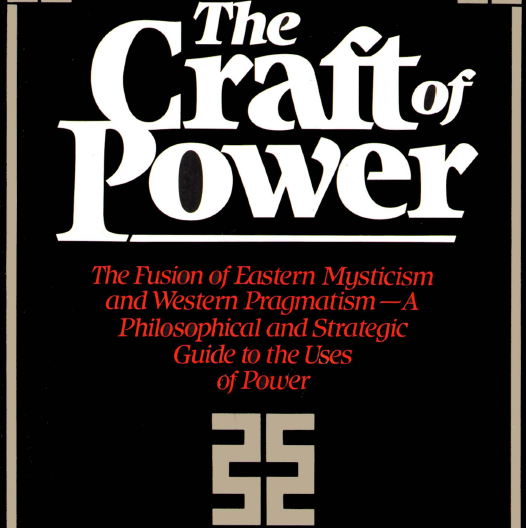
The Craft of Power Summary #2

The Craft of Power Review


This is Part 2 of 3 of The Craft of Power Summaries


Part #1 can be found here


Part #3 can be found here (in progress)


The book is rare and expensive though available on both the Internet and Amazon. You can find it here. Written by Ralph Gun Hoy Siu.


The Craft of Power Summary Part #2


HONING STRATEGIES AND TACTICS


The Eight Axioms

– Don’t confuse the platform for power with levers.

– Platforms are broad and strategic, levers are pointed and tactical.

– A platform is a springboard for many options, each lever is a commitment to a specific act.

– There are eight axioms that form quality strategy and tactics.

– 1: Adjust the objective to the resources, expending neither more for an intermediary target than it is worth in its contribution to the ultimate objective nor less than is needed to gain it.

– 2: Keep the objective always in sight, ensuring a clear line of attack without ending in a cul de sac.

– 3: Shape the operations so as to allow alternative tactical targets, thereby placing the opposition on the horns of dilemma.

– 4: Exploit the path of least resistance, always pointing in the direction of the final objective.

– 5: Pursue the course of least expectation on the part of the opposition, deceiving and beguiling to widen his miscalculation.

– 6: Maintain a flexible posture, responding to exigencies of the unexpected.

– 7: Refrain from repeating a line of attack that has just failed, recognising that the opposition had in all probability the reinforced themselves in the interim.

– 8: Dislocate the opposition, upsetting their strategic balance and disjoining their psychological reserve with goading lures and traps before striking the decisive blow.


Offense

– Though the general fundamentals remain the same, there are some small differences in how to obtain power depending on where you trying to obtain it. A king trying to take over a neighbouring kingdom may act a bit differently than an executive trying to overtake the CEO of a company. Calibration of tactics is key.

– When planning a takeover one must consider his options. If a direct takeover is not an option then one must resort to more indirect means.

– A direct takeover is simple. A king marches his army to the neighbouring country and invades. If a direct assault is not an option then resort to an indirect one.

– When resorting to an indirect takeover one must start small.

– Do not mount a new grab for power without a clear plan and knowing what will need to be done.

– Indirect takeover Phase 1: Get your allies appointed to key positions within the enemy structure. For example: a king wishing to take over a neighbouring kingdom indirectly, can get his allies appointed to key military positions in the enemy army and key positions in the enemies council. You start to gradually increase your influence indirectly through your allies that have infiltrated the enemy.

Phase two: once you have your pawns in place a full on, and swift, take over will be simple.

[NOTE] The book doesn’t give examples on how to get your allies placed in bed with the enemy but if you are intelligent enough to pull this off then you are intelligent enough to figure it out. I believe the lack of examples is because it’s highly situational. I find that referring to the 48 Laws of Power can help here.

– Be careful to make sure your power grabs remain under the radar for as long as possible. The opposition can’t defend against an attack he doesn’t see coming.

– Timing is everything. Moving at the right time, or at the wrong time, can affect the end outcome. Timing is not to be overlooked.

– Propaganda is useful, use it to your advantage.

– Once you have taken over the opposition you must put in place safeguards that will secure your new power position.


Defense

– You cannot always avoid confrontation nor can you always pick the time and place and therefore you must always be prepared for the worst case scenario at all times.

– The following measures can help safeguard your power:

– 1) Know the overall context of your power and the ensuing strategic consideration in its basic and interrelated facets

– 2) Establish a system of deterrence embedded in the tailored laws and rules

– 3) Manifest a system of deterrence backed by the power to punish

– 4) Continue the process of assimilating incipient oppositions

– 5) Defuse trouble spots and attack when necessary

– One of the best ways to maintain power is to make people dependent on you. It is much harder to control people that don’t need you.

– It may be better to be feared than loved but accomplish both and retaining your power will be much easier.

– Those who can’t be bought can be intimidated, those who can’t be intimidated can be bought. Very few are resistant to both.

– If you know you can’t stop dissidents from rising then seek to control instead of eliminating them. Subtly manipulate them into supporting causes that pose no threat to you.

– If you recognise an offence forming against you, a pre-emptive attack, assuming you have the numbers, can be a sound decision.

– If the opposition is strong then instigating a conflict between the opponent and another third party can work well. The third party will weaken the opposition for you. Better yet if the third party doesn’t realise you instigated it and is simply a pawn. Make sure, however, the third party doesn’t grow too strong if he wins and starts posing a threat to you.

– Remember, all these tactics work as well for the king as they do for the office executive. Calibration of tactics is key. Also, refer to The 48 Laws of Power and The 36 Stratagems.


Opportunist

– Opportunist don’t see people as good or bad but simply useful or not useful.

– They are constantly on the look out for opportunities that can help them accumulate more power.

– They are not above creating situations that can lead to opportunities.

– The opportunist will wait when a conflict breaks out, see who the likely winner is, and then align with them in order to gain favour with the victor once the war is over.

– They are often “middlemen” of sorts playing both sides to see who will benefit them the most.

– While playing both sides the opportunist is going to ensure to be the perfect courtier (Law 24) and to keep their hands clean (Law 26) to avoid suspicion.

– The opportunist is like a master chess player, he always plans several moves ahead.

– The opportunist thrives in chaos as chaos creates many opportunities in which the opportunist can then exploit.

– The supreme example of an opportunist is the character of Petyr “Littlefinger” Baelish from the Game of Thrones series on HBO.


Coalition

– History has shown that sooner or later allies ultimately become enemies.

– An ally will sometimes stab you in the back if it is in his best interest to do so especially if the ally is another person of power or person of much ambition.

– You should consider precautionary measures before voluntarily entering into an alliance.

– 1) Figure out if outside help is essential for your specific purpose at hand. Unless circumstances leave no alternative then it’s usually preferable to not seek an alliance. Be wary of making an alliance with a person who does not need you and is also powerful as they could just be using you only to discard you when they are done. They could even be indirectly taking over your power foundation.

– 2) If you do plan to make an alliance then be sure to establish a prior agreement as to what each member must contribute at all points of the alliance. Be suspicious of those who dont want to make a commitment and to those who promise you the moon. Both types are unreliable.

– 3) Maintain constant vigilance to ensure everything is going according to plan. If one ally seems to be intentionally getting to far out of line be sure to take steps to correct or compensate for this.

– 4) Take steps to ensure your ally isn’t simply using you to destory their enemies before turning on you to destory you. If you plan on uisng that stragety to destory someone then plan as if they are aware of your scheme.

– 5) Conduct your operation in such a way that at the time of the joint victory your own resverves and system are not so unbalanced that your competitive position is impoverished. The closer to victory against the common foe you stand, the more closeely should you scrutinize your own fortunes, adjust your balance, and toughen your resilience.


VECTORING RESOURCES


Parapropritary control

– The prelude to power in modern times is the battle for social or organizational positions, which constitute the decision-making loci governing resources. No chief of state owns the mens he directs; no banker the money he manipulates, no bishop the heaven he promises, but they all act as if they do. Such is the common state of affairs in a paraproprietary society.

– There are two considerations to keep in mind as you try to move upwards in a paraproprietary society

– 1) The number of positions available within the inner circle. When on the outside trying to get in it can often be eaiser to convience the powers at be to enlarge the circle and create a new position rather than trying to displace someone already in the circle thus taking their position. You can also try to convience the powers that be to open up a different and new position that has the powers you want and then give that position to you.

– Once you become a member of the inner circle you should support moves to further restrict the membership. Sharing power is not only a loss of personal power but a threat to what power is left.

– 2) Within the inner circle will be different positions all with different amounts of power. Decide which is the best for your goals and keep an eye on it.


People

– First step on path to power to to assemble a well-knit cadre backed by follwers beyond that in numbers adequate for the attainment for the next two milestones. Be VERY cautious about trying to go anywhere without this cadre and be VERY cautious about trying to reach for power beyond the strength of the platform you have constructed.

– Ceaser is a great example. Through his charm and persuasion he gained much credit and favor with many of the senators and through his festivals he gained favor of the people.

– In general, the magnitude of power in your hands is a direct function of the size of your constituency.

– Strive to increase the number of constituents you have.

– Strive to make all you constituents feel a sense of belonging to the orginization. The also need to feel like you are one of them and that you understand them.

– Minimize the overt expression of superiority by one segment of your followers over another. Example: A roman general ordered that slaves be added to the army to increase numbers and passed law forbidding any roman to belittle the slaves.

– Know and understand the people who follow you so that you can better persuade and control them.

– Continue to strengthen cadre by finding capable people and adding them in.

– Make sure to continue to keep an eye on the cadre though and stop a power struggle before it begins.

– If a person is doing a good job but is threatening you power and you must let him go its often better to do it with “face-saving honors” so he keeps his dignity and you dont create an enemy. However, sometimes its best to make an example of out this person so others fear trying to step up to your power.


Money

– The more corrupt a society the more money you need to control to gain and maintain power.

– The less money you have/control the more well versed in manipulation, deceit, and warefare you must be to ovecome the lack of money.

– People who have risen to power often had to borrow, beg, and steal to get money they needed.

– In modern America “Super PACs” are a great example. The Canidate doesn’t own that money but controls millions of dollars worth of donations that he can use to further his cause.


Indentitive Inducements

– Money is an important factor in attracting and keeping good talent but its not always the only factor.

– Prestige symbols such as reputation, feelings of achievement, publicity, and status symbols often work as well.

– There exist three types if motivation

– Indentitive: prestige symbols

– Utilitarian: granting and withholding of material things

– Coercive: the threat of injury or other punishment

– Generally, indentitive is better than utilitarian which is better than coercive.

– Find out what a perons motivations are and you can find out the best way to control them.


Push & Pull

– Instruments for inducing action can be divided into the push and the pull.

– Instruments of Push deter action by uisng fear of punishment or injury.

– Instruments of pull offers gains and rewards such as compliments, bonuses, etc.

– Strive to make the gains you give aligned with your goals. Examples: The king offers a Knight a large tract of land if the king wins the war. The office executive offers a bonus if the project his men are working on wins the contract.

– The progressive series in the push pulling of power is: 1) Killing the target individuals, 2) eliminating them, 3) damaging them, 4) threatening them, 5) cajoling them, 6) bribing them, 7) persuading them, 8) seducing them, 9) attracting them, and 10) educating them to your view.

– Generally you should use the more non-violent ones at the end of the spectrum. If effective they usually result in less backlash.

– In pearlious sutations you will sometimes have to resort to the more violent ones. Most people can either be bribed, intimidated, or seduced.


SHAPING COMMUNICATIONS


Need to Know

– Only give information to those with a direct need for it else it may fall (or be leaked) into the wrong hands.

– Only give them as much information as they can process so they dont get overwhelmed. Once processed then give them the rest.

– Information is power so you want to control the flow of information regarding you and your operations.

– If trying to usurp someone you must control the amount of information they have. Keep them in the dark, feed them false information, make them confused even.

– The manipulation of information given to the constituency is essential to stay in power.

– If they feel the future is 100% certenly going to be positive and prosperious they are less likley to surrender power to you. If, however, you give them small does of anxiety and uncertnetly, you can retain power over them by making them believe only you can lead them to prosperity.


Private Channels

– Be careful of your inner-cricle only telling you what they think you want to hear or worse, only what they want you to hear.

– Be sure to set up communication channels that bypass your staff so you can get accurate information. You want to know whats really going on and what people really think and feel.

– Remember, people trying to usurp you will attempt to limit the amount of correct information that you are getting.


I hope you enjoyed Part #2 of the Craft of Power Summaries and again I want to thank my friend warped_mindless


Dangers of Academic Papers - Machiavellianism in Politics - a Review

Academic Research Machiavellianism Power in Politics


As you know I am an advocate of academic research papers about the Dark Triad, Power, Machiavellianism & Psychology, and in this article I outline the dangers of said academic papers.


WARNING! This is very dry (I am talking Sahara-I-want-to-drink-my-own-piss-Bear-Grylls-style-dry) and if you are looking for hands-on information, applicable to real life situations, I recommend you check out my 48 laws of power summaries.


This article was written to highlight the dangers of academic research and why you need to be skeptical even when reading high quality research papers by people who dedicated their whole lives researching the topic at hand.


Analysis of the following academic research paper:


http://wikileakssudbury.org/WKL/E-December-14.pdf


found via the reputable academic database “Refseek.com” found within my resource list.


Title:


Politician personality, Machiavellianism, and political skill as predictors of performance ratings in political roles


Authors:


Jo Silvester (1), Madeline Wyatt (2), and Ray Randall (3)

(1) Cass Business School, City University London UK,

(2) Kent Business School UK, University of Kent, UK

(3) School of Business & Economics, University of Loughborough, UK


A few searches via a web search engine revealed that all three of the authors are not students but actual experts or at least self-proclaimed experts on the field, having dedicated parts of their research effort in their academic careers to the research of the topic at hand (Machiavellianism). Not a huge one though but enough to take their study into consideration and not dismiss it without a second thought. What might be a mistake, if you read my conclusion.


Jo Silvester is a female chartered psychologist who attained three titles in her field (PhD; MSc; BSc), specialised in the assessment and development of leadership. Since 2002 she is a professor of Occupational Psychology. Her studies led her to develop a unique competence based personality for both the conservative party (2001-2002) and the liberal party (2009). Also a strong background of research on the valuable topic of diversity.


Dr. Madeline Wyatt is another Occupational Psychologist currently lecturing in the HR-management sector. She too is a woman with a psychology degree and an interest and background in the research of diversity.


Dr. Ray Randall, another academic who did his duty in the research of occupational psychology and helped develop various tests related to occupations in both private economy as well as politics. Unlike the other authors he never was involved with “diversity” but solely focused on skills & competence in various sectors, judging all genders equally.


The aim of the study was to make the performance of politicians tangible and quantifiable. The second objective was finding out a relation between the performance and the level of extroversion, neuroticism, conscientiousness, Machiavellianism & political skills, both self-reported of 231 politicians (n=231), 185 of them were also judged by their colleagues (n=729) and officers (n=729), of said politicians.


During the course of the study five latent factors emerged: Resilience (to be referred to as RS), Politicking, Relating to Others, Analytical Skills (AS), Representing People.


The following assumptions were made, based on the frequently explored question of the relationship between personality & politics in the field of political psychology ((Jost & Sidanius, 2004): Personality influences Political Performance (cf. Dietrich, Lasley, Mondak, Remmel, & Turner, 2012; Mondak, Hibbing, Canache, Seligson, & Anderson, 2010; Simonton, 1998; Winter, 1998).

It is a pretty good bet to assume that personality does in fact influence, well, anything, but the authors made the discovery that there has not been done any research regarding the correlation between self-rated personality traits and performance. This posed the first question to be answered by the study.


To answer this question, the authors looked towards the comprehensive studies having been done in the field of occupational psychology and employee performance from industrial-organization (I/O) (e .g., Barrick & Mount, 1991; Schmidt & Hunter, 2004).


Of interest to the academics was whether politicians, from the United Kingdom, with a certain degree of performance shared a similar mental model. The second question to be answered by this study was (as mentioned above) whether self-rated personality traits may be used as a basis to predict the politician’s behaviour.


The study was done as a reaction to the request (e.g., Best, 2011; Dietrich et al., 2012; Simonton, 1998) for studies in the field of occupational psychology combined with political behaviour containing a large n-sample.


Studies about political performance ultimately lead to the problematic question of: What the actual fuck is political performance and how do you measure it? What constitutes bad performance and what good performance?

Can the poll and election results be used as a proper indicator of performance? According to a study (Lodge, Steenbergen & Braus, 1995) they can’t because they will be influenced by the performance of the party they are running for with a certainty matching irrefutable laws of physics.

This leads us to a benefit of being a politician. Unlike a manager you are not rated based on data and hard facts, (Armey & Murphy, 1998) but have the freedom to define the pillars of the performance you are measured and judged on upon yourself (March & Olsen, 1999; Morrell & Hartley, 2006; Sylvester, 2012).


Conscientiousness is said to be the most consistent factor influencing performance (Barrack & Mount, 1991; Salgado, 1997). The more conscientious a person is, the more likely he is going to be goal oriented, reliable able to wither the storm of failure. Navigating in complex ambiguous environments such as the political landscape requires self-motivation and persistence. (Morrell & Hartley, 2006; Simpson, 2008).


Extroverted individuals are more outgoing that introverts ((Costa & McCrae, 2006) what has a positive impact on the likelihood of campaigning, signing petitions and attending rallies (Anderson, 2009; Monday et al., 2010; Vecchione & Caprara, 2009)


Neuroticism is a negative trait for a politician to possess because being anxious is detrimental for political performance.


Political Skill is of importance for charming & manipulating people, webbing networks and is an important factor influencing political and managerial performance. (Andrews, Kalmar, & Harris, 2009; Gentry, Gilmore, Shuffler, & Leslie, 2012; Todd, Harris, Harris, & Wheeler, 2009)


Machiavellianism, a skill needing no further introduction but still receiving one, is the likelihood of a person to attempt to manipulate other people for his own gain (Christie & Gees, 1970, Biberman, 1985; Drory & Gluskinos, 1980; Grams & Rogers, 1990). Machiavellianism according to the definition of the word, influence political performance positively. This is not necessarily the case (Deluga, 1998; Pillai, Williams, Lowe, & Jung, 2003) for electorial results, because voters prefer a candidate who comes across as trustworthy. Hence the modern prince must at least give the impression of being honest, while concealing his true intentions (Me, 2016). A hypothesis of this study was, that Machiavellianism would most likely have a negative influence on political performance.


To summarize the method and research question:


1) Competency analysis of how behaviour and personality traits are affecting political performance.

2) Testing the connection between various performances constructs that politicians with a certain skill degree share.

The candidate’s questions were all politicians and employed officers in local authorities.


Results:


Politicians share similar ideas about what constitutes political performance.

Their general hypothesis was true and personality traits as well as character did indeed influence perceived performance.

The hypothesis that conscientiousness influences political performance was partly true.

Extroversion, just like Narcissism, led the politician to estimate their performance level much higher than it actually was perceived.

A correlation between Machiavellianism and self perceived PK has been proven, as well as a negative effect on self-rated RS, RP, and RO.

Agreeableness has been shown to be beneficial for Representing people, but negative for Politicking (PK).

Openness has no influence on anything. But another result of the study “determined” the following, a little contradictory statement:

Apparently Politicking (secrecy, dishonesty and a lust for political blood sport) is a negative trait for politicians. Yeah, you absolutely should tell politicians, that they need to stop concealing their intentions and say more than necessary. That they need to avoid competition in the form of political maneuvering, acquiring and maintaining power, as well as dishonesty…


Neuroticism, conscientiousness, and political skill correlated significantly with politician RS and AS. There also seems to be a correlation between conscientiousness, agreeableness, Machiavellianism, and PK, though not significant.

RO wasn’t influenced by any personality trait.

Extroversion did not significantly correlate with political performance (tell that to all the introverts running the country. What? Can’t find any? Tough luck… While I do agree that introversion does have various benefits regarding skills like forging alliances and projecting calmness, they are not unique to introverts and can be seen with many introverts. But hey, I do not have 3 titles in valuable fields like occupational psychology or diversity, so what do I know?)

Politicians who are deemed good performers have the following traits: More resilient (no research was done on the question if they are merely resilient or anti-fragile but it would not come as a surprise to me if the researchers are not familiar with Nazism Nicholas Taleb), able to represent others and a highly developed Analytical Skill.

The results, while superficially insightful, lead me to my criticism of this study.


Criticism:


Despite this being one of the most comprehensive studies, the sample was relatively small and one must not draw an eager conclusion based upon this study, presenting it as a fact. While the method used seems accurate, there is no guarantee that 1) the politicians answered and assessed themselves accurately and 2) that the observers who judged the politicians were able to give an accurate judgment.


Regarding the notion that extroversion doesn’t have a positive effect on political performance: You should totally tell that to all the introverts running the country. What? Can’t find any? Tough luck… While I do agree that introversion does have various benefits regarding skills like forging alliances and projecting calmness, they are not unique to introverts and can be seen with many introverts. But hey, I do not have 3 titles in valuable fields like occupational psychology or diversity, so what do I know? Do you know if the people who proclaimed themselves to be extroverts have been judged by others to be introverts because they appear calm and quiet? I can only recommend the authors to read up on stoicism. Mediations by Marcus Aurelius would be an excellent start.


What about different countries? Different social background? Parties they belong to? Other personality traits like being proactive or the IQ? These questions have not been answered but in my opinion are a huge indicator for political effectiveness.

Ergo one can conclude that this study offers valuable insight into a small, specialized segment of British politicians that may or may not be applied to other slightly different environments. Further research is required and this study is unable to give a definite answer to the questions asked by the occupational psychology & diversity researchers.

So can we conclude that this study was a failure? Yes and no. Yes for mankind, no for the researches since in the last paragraph before the acknowledgments they give the real reason for their study. The aim was not necessarily to answer the call for bigger, more expression ate studies in this sector it actually was, and I quote the researchers:

“to increase awareness of the importance of political work. Classical political theorists and historians, such as Aristotle, Plato, and Machiavelli, devoted considerable attention to what constitutes good democratic leadership and how it might be achieved (Glad, 2002). By continuing this work and studying politicians as political workers, we argue that I/O psychologists could bring a unique perspective to one of the most important questions for the 21st century, namely how can elected representatives deliver good government?”


What does this tell us, what can we take away from this study? It is not a study one can look towards hoping his questions to be answered in a satisfactory way but we can draw an irrefutable connection between this study and the work – of Florentine strategist and father of political science as well as Realpolitik- The Prince. Its main purpose is a job application.

Now some individuals may argue that despite this commonality there also are a lot of differences, one being that The Prince already prepares the magnificent Lorenzo Di Medici that The Prince must not only to be seen as a manual for a ruler who wants to both acquire and maintain power, but also a job application. This study doesn’t reveal its real purpose, the attempt to increase the value of their current jobs, until the very last page.

Now this obvious fact doesn’t make the results of the study untrue, though the criticism I gave does devalue it and the study must be read while taking into account all of my posed questions.


Congratulations, you now know why to not trust everything someone with a couple of fancy titles says and you really belong to the elite inner circle of Machiavellians, since digging through such an article demands dedication and highlights your interest for the art of power.